
August letter from Cambridge
Summer reading (new books and old), suffragettes and sisters

Suffrage posters
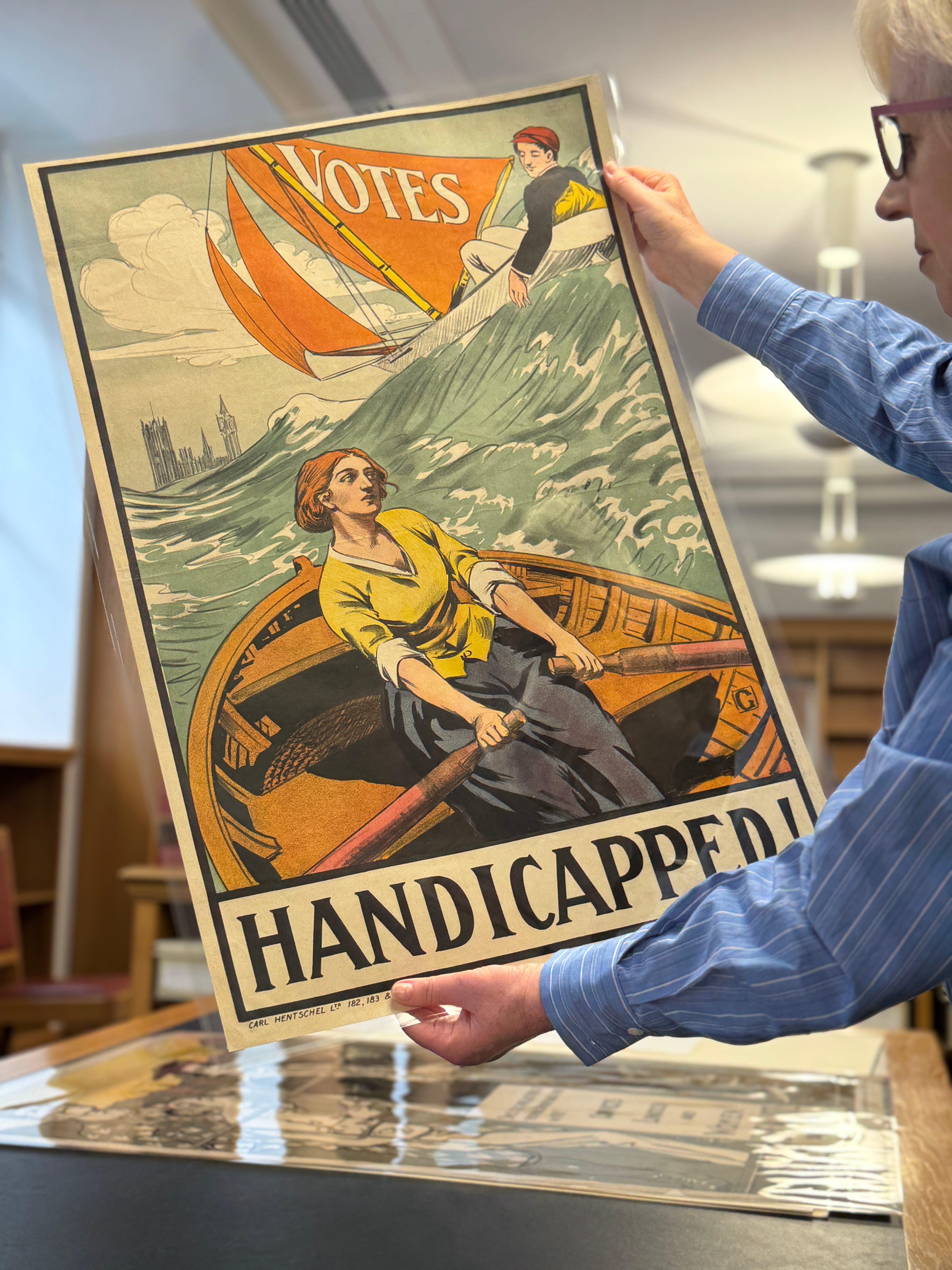
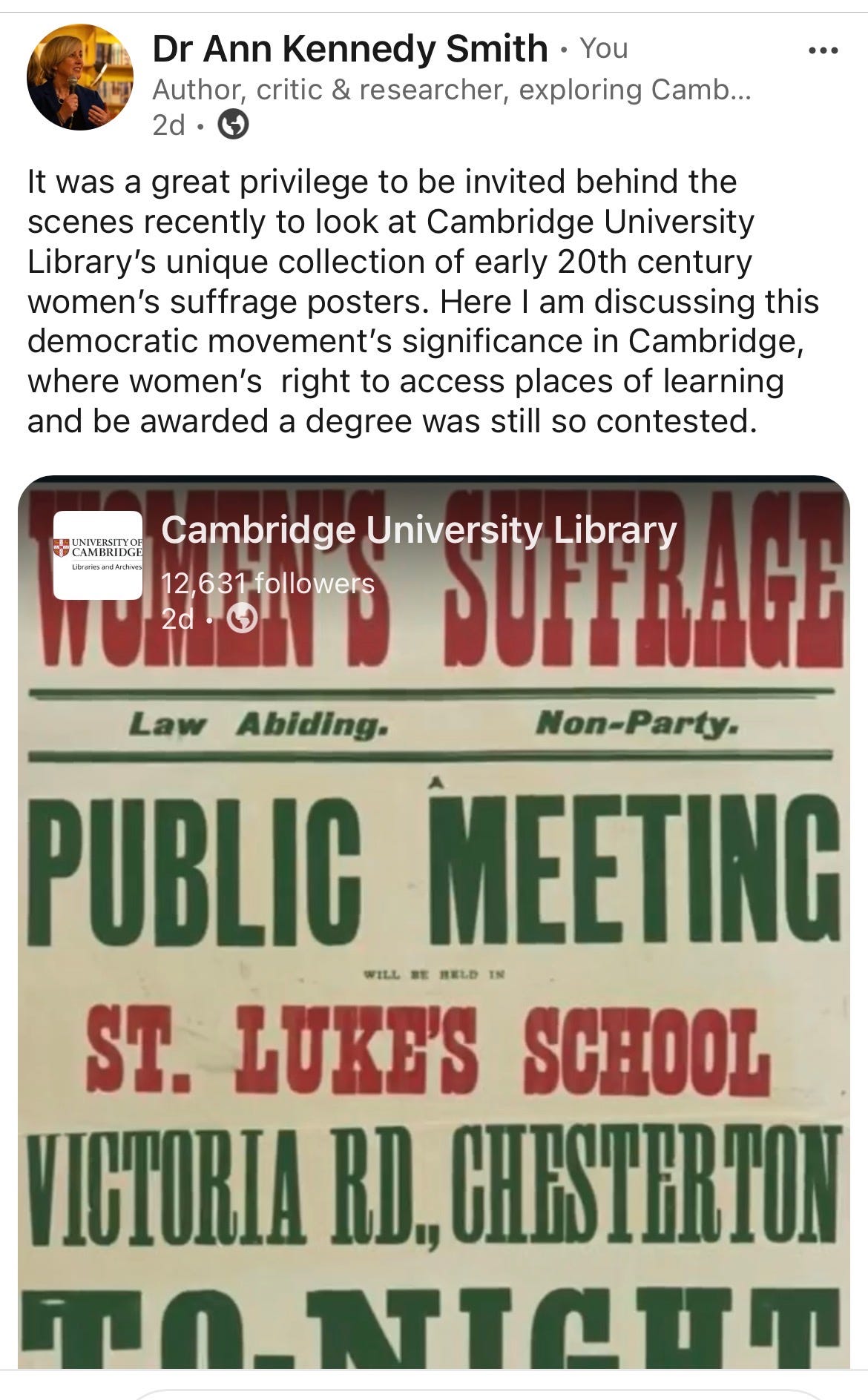
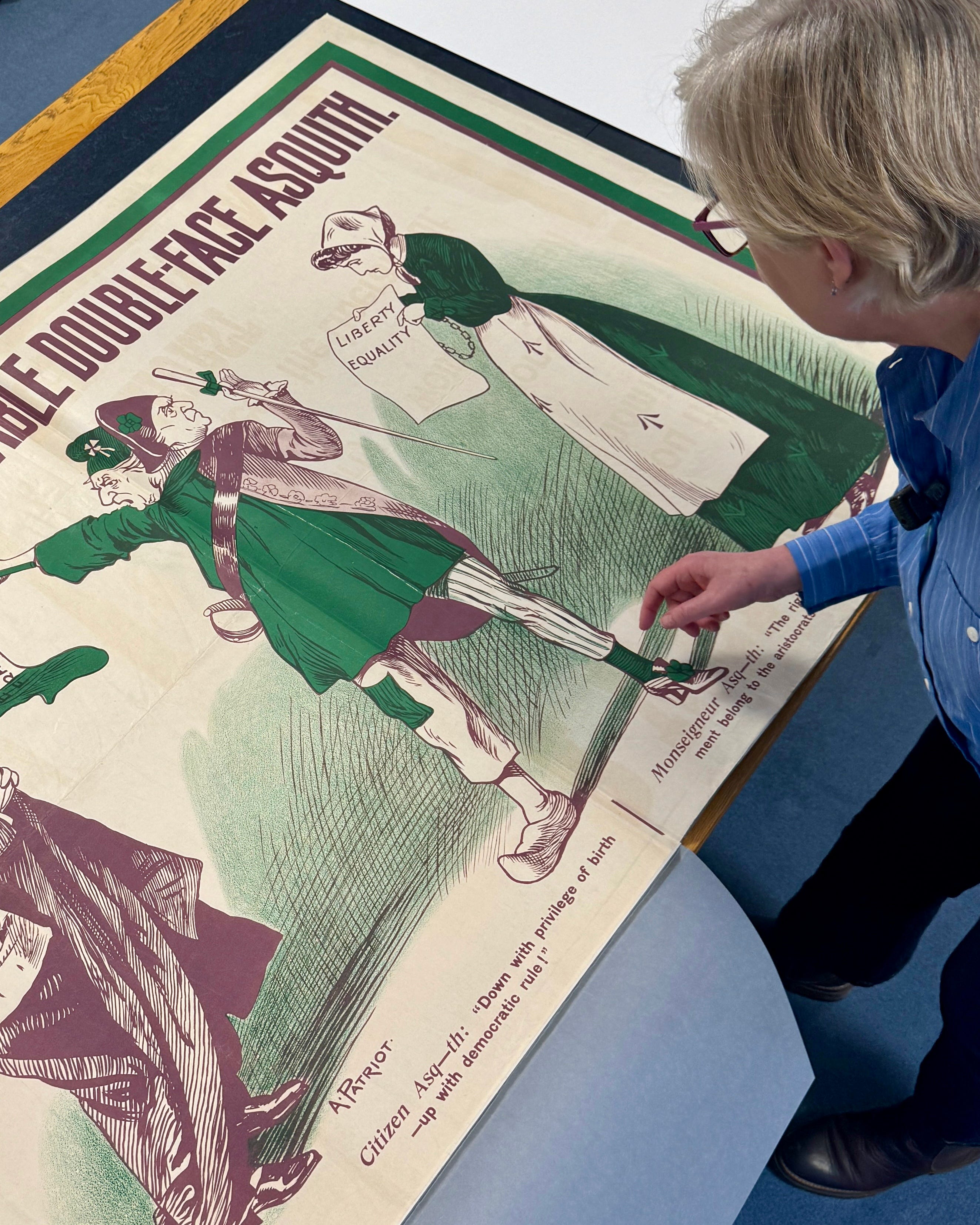
It was a great pleasure to be invited behind the scenes recently to look at Cambridge University Library’s unique collection of early 20th-century suffrage posters. As I mentioned in my previous post about Ray Strachey, if you look closely you can see a copy of one of the posters just visible in the photograph of Strachey giving a speech from the suffragists’ horse-drawn caravan. The Library has kindly shared a short video of me talking about a poster advertising a public meeting, and its particular significance for Cambridge, here. Below is a photograph of me looking at a striking poster designed by Duncan Grant, awarded first prize in the 1909 Artist Suffrage League’s poster competition and depicting ‘“a stalwart Grace Darling type struggling in the trough of a heavy sea with only a pair of sculls, while a nonchalant young man in flannels glides gaily by, with a wind inflating his sail – the vote – [treating] with good temper a subject which often causes bitterness.” The Houses of Parliament loom on the horizon as the goal of both vessels.’1 You can find out more about CUL’s suffrage poster collection here.
New books
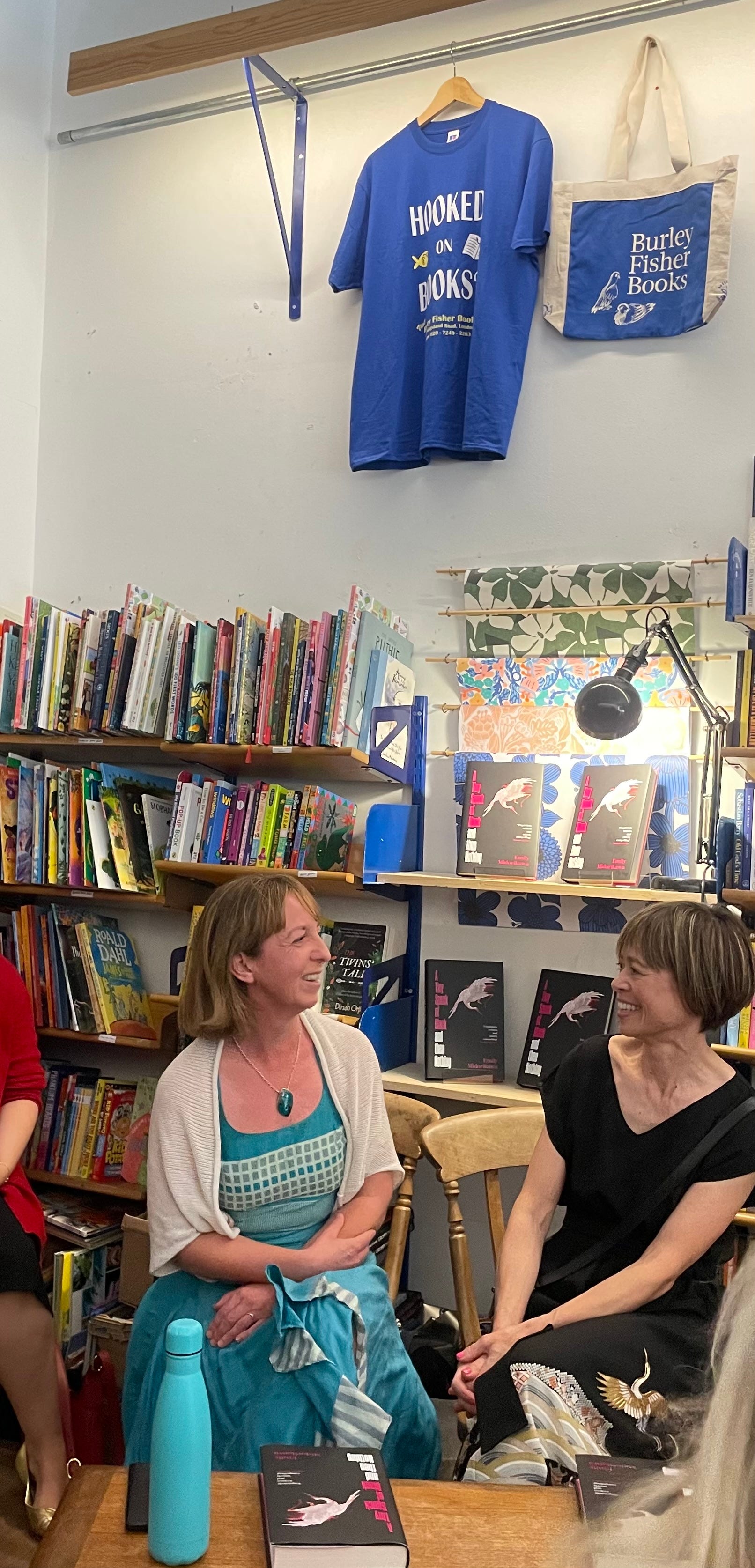
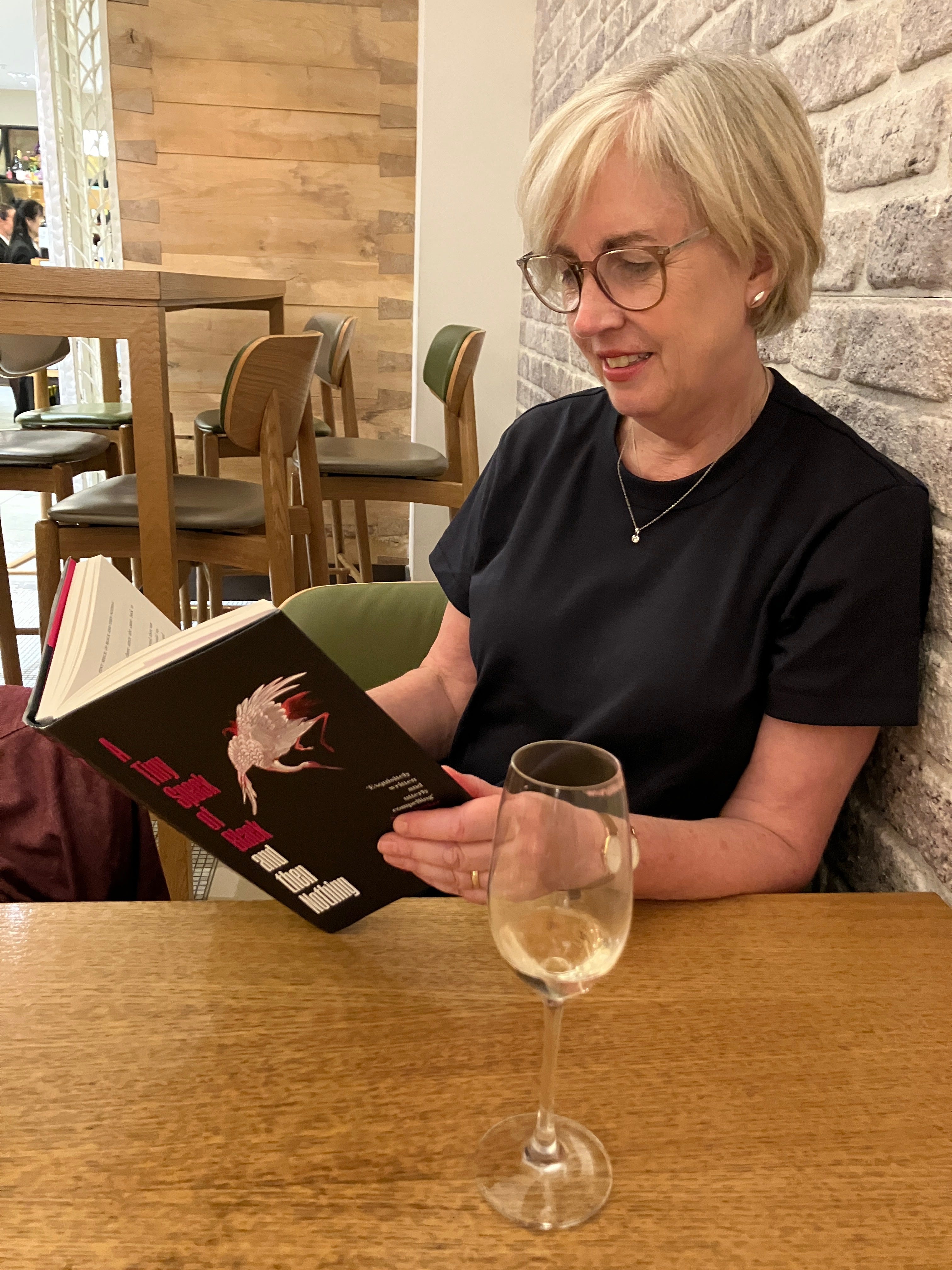
I was delighted last month to have been invited to attend the celebratory launch of Emily Midorikawa’s new book, A Tiny Speck of Black and Then Nothing (published in the UK by Bonnier Books, 2026; USA publication November 2026). I was saving her novel up for my holiday reading… but as you can see from the photo below, I haven’t been able to resist starting it now (with or without wine). It’s a gripping mystery set in Osaka, Japan in the 1990s, when Anna arrives to teach English and discover more about her Japanese heritage. She befriends a mysterious nightclub hostess called Loll, and when she disappears, seemingly without a trace, Anna is drawn into trying to find her. There’s a great, funny post about the background to the novel on The 400-Year-Old Library’s Substack here, and I also recommend subscribing to Emily’s blog here.
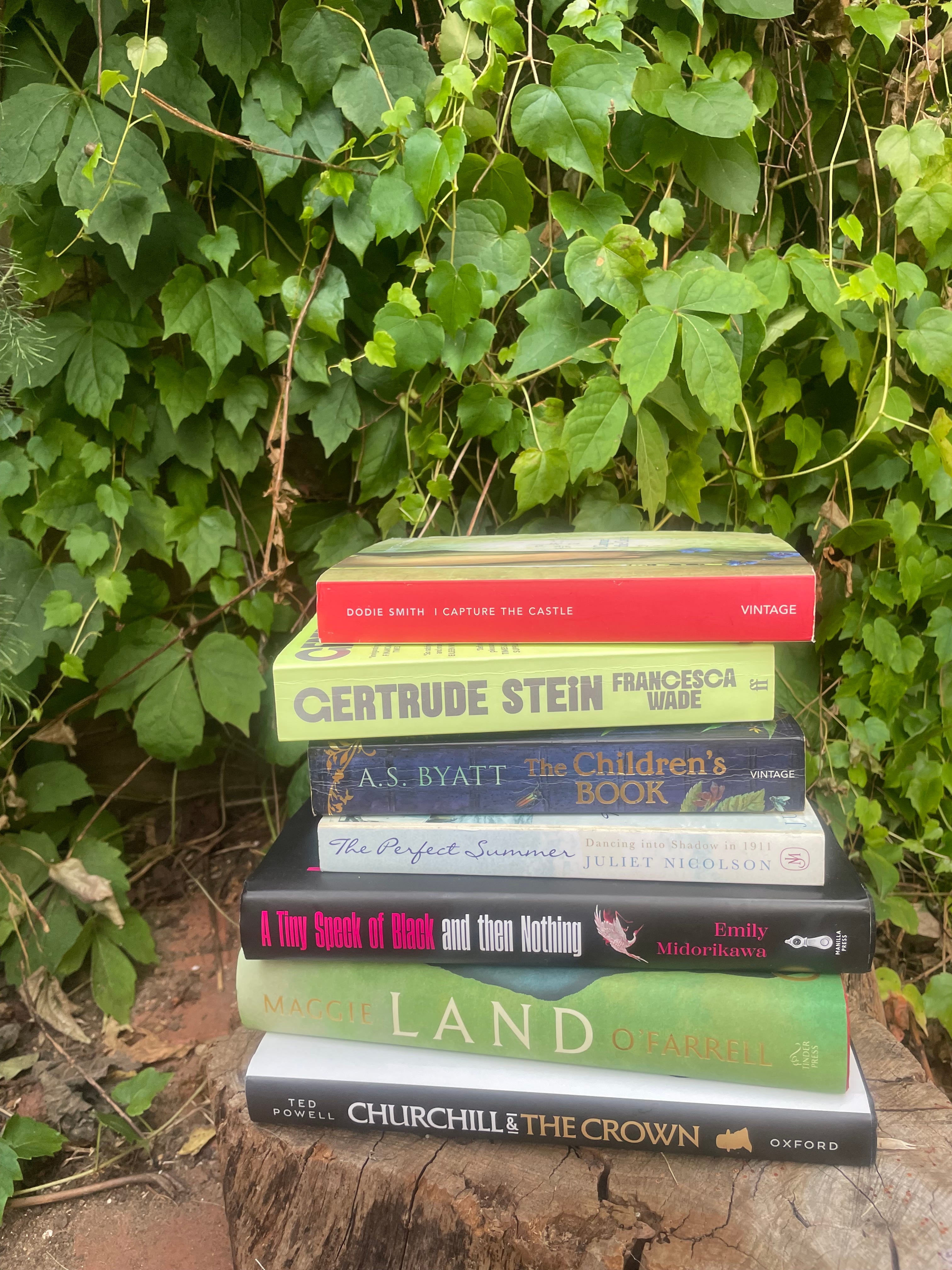
Other newly published books are also clamouring for my attention. Following my talk about the Cambridge Ladies’ Dining Society to another historic dining society last month, I was very kindly given a copy of Land by Maggie O’Farrell. It tells the story of a mapmaker and his family that begins in 1865 on a nameless western penninsula in Ireland, and promises to be a thoroughly immersive read. As Claire Connolly writes in the TLS, ‘Land confronts the central trauma of nineteenth-century Irish history, the Great Famine, while giving voice to one of its most frequently told stories, that of the Ordnance Survey of the island’.
I will need to make room in my pull-along expandable suitcase for two recent biographies: the first is Ted Powell’s highly readable Churchill and The Crown (OUP, 2026), described by History Today as ‘a superbly researched and revealing study of a side of Churchill’s public life hitherto neglected by biographers and royal commentators alike.’ In his engaging introduction, Ted describes how, as Prime Minister in the early 1950s, Winston Churchill helped to shape the new Queen Elizabeth’s public persona, and in April 1955 one of his last acts as Prime Minister was to entertain her and Prince Philip to dinner at 10 Downing Street. ‘For Churchill, who had served five generations of monarchs, the evening was the final glittering highlight of his career. Yet arguably he now lent as much prestige to the monarchy as he gained from it.’
Francesca Wade’s Gertrude Stein: An Afterlife (Faber paperback, 2025) is an investigation into the principles of biography writing, and how lives are memorialised, as well as an engrossing study of a creative woman’s life and work. The book that made Stein world famous was The Autobiography of Alice B. Toklas, published in 1933; it’s fitting that her enigmatic life partner Toklas, and how she guarded Stein’s legacy, plays a major part in ‘Afterlife’, the second half of the book.
Film review hoo-ha
In July’s ‘Letter from Cambridge’ I wrote about the new adaptation of Virginia Woolf’s 1919 novel Night and Day. Since then, another classic work of literature has been making news headlines… so, have you been following the discourse on Christopher Nolan’s new film version of The Odyssey?
It was a treat last week to read The Odyssey’s recent translator EMILY WILSON’s no-nonsense review of Nolan’s film, ‘An Uncomplicated Man’, in the London Review of Books (her article is free to read via this gift link). She has also published a recent interview on Substack, in which she talks about the film, here.
‘I very much hope many people go and see it in cinemas – it’s worth it to see on the big screen, because so much of the movie is about the visual effects, as well as the very loud sound track. This film is an event, and it has a lot of memorable moments. But I hope those who do so will also read or reread the poem. I hate to be that guy, but the book is a lot better than the film.’
Given all the hoo-ha that resulted from her LRB article, Wilson’s Substack post has a very appropriate title, referring to one of her favourite poems, ‘If–’ by Rudyard Kipling. ‘If you can bear to hear the truth you've spoken/ Twisted by knaves to make a trap for fools...’ Personally speaking, I am looking forward to reading Wilson’s translation of Homer’s Odyssey all the more AND listening to Claire Danes reading it via audiobook. And don’t miss this witty article by Lucy Writes History on the kerfuffle.
A complicated man
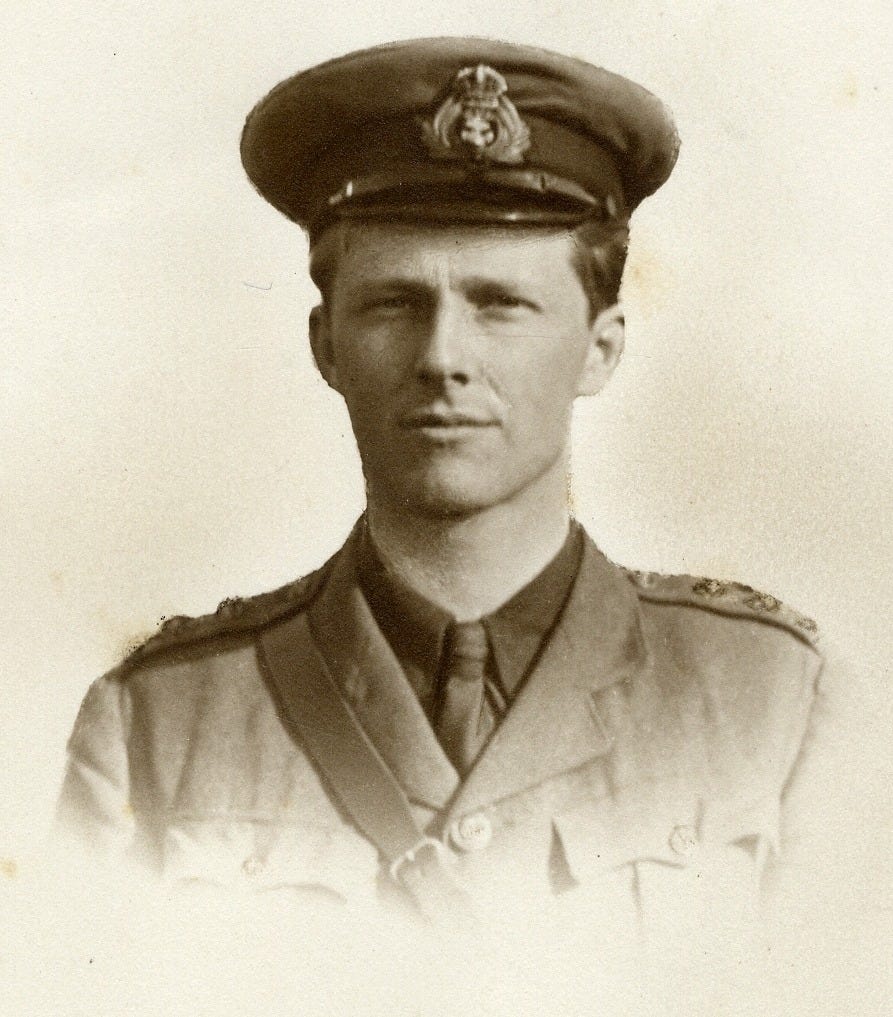
If I should die, think only this of me:
   That there’s some corner of a foreign field
That is for ever England. (From 'The Soldier' by Rupert Brooke, 1914)
‘Tell me about a complicated man’ Wilson’s translation of The Odyssey famously begins; her words could apply equally to the poet Rupert Brooke, whose poetry was used by Churchill and others as war propaganda following his death in 1915. In 1911 he espoused a ‘back-to-nature’ philosophy, and he and his idealistic male and female friends were dubbed ‘the Neo-Pagans’ by Virginia Stephen (later Woolf). When, that hot summer, she visited Brooke who was then living at the Old Vicarage in Grantchester, she wrote that ‘his feet were permanently bare; he disdained tobacco and butcher’s meat, and he lived all day and perhaps slept all night in the open air.’
I’ll be giving a talk about Woolf’s pre-war friendship with Rupert Brooke tomorrow in central Cambridge for participants in this summer course organized by Literature Cambridge. If you ever get the chance, do visit The Orchard in Grantchester, where Brooke once lived, and have tea sitting in a deckchair in the shade of the apple trees. Let’s hope some of our relentless summer heatwave has diminished by then.
Two novels about that long, hot summer
As background reading, I’ve been enjoying Juliet Nicolson ’s The Perfect Summer: Dancing into Shadows in 1911 (John Murray, 2006). It’s about the momentous events that took place in the exceptionally hot summer that year, and follows events in England through the eyes of real-life people from different social classes including ‘a butler, a Queen, a choirboy, a society darling and a trade unionist’. I particularly like her depiction of Mary Macarthur, the charismatic Scottish suffragist and general secretary of the Women’s Trade Union League, who in August 1911 helped to bring about a historic victory for 14,000 low-paid women workers following the Bermondsey Uprising.
Nicolson’s book a worthy companion to A.S. Byatt’s novel The Children’s Book (Vintage 2010), which follows the lives of several interconnected families from 1895 until the First World War. Byatt expertly combines fictional characters with real people (including Rupert Brooke and the Olivier sisters) and sets their stories against a backdrop of historical events. Towards the end of the book she memorably depicts the febrile atmosphere of that lengthy heatwave in England, and how it affected people very differently according to their social status.
‘In 1911, King George V was crowned in Westminster Abbey on June 22nd in the middle of the longest hottest summer the country had known. The King took a measure of 98 degrees Fahrenheit on his greenhouse thermometer. Neo-Pagans slid naked into cool pools in Grantchester, under hanging boughs, and hid giggling in the undergrowth, watching punts pass, full of tourists and dons ... [meanwhile] the poor, the workers and their dependants, were stirring with discontent, dissatisfaction and even rage, all over the country.’2
It’s worth noting (with reference to the suffrage posters that I saw) that in 1911 the UK’s Prime Minister, Herbert Asquith, promised to address the question of women’s suffrage on condition that the suffragettes agreed to stop their campaign of direct action – smashing windows, setting fire to golf courses – during the Coronation summer.
The suffragettes kept their word, and did not disrupt the royal celebrations, but judging from the suffrage poster below, ‘Double-Face Asquith’ failed to keep his. The suffragettes’ campaign escalated after that, as did the government’s response to it, including the infamous ‘Cat and Mouse Act’ of 1913 which instead of force-feeding hunger-striking women (as above), allowed them to be freed temporarily, only to be re-arrested. In my next post, I’ll write about the New Zealand-born Fannie Parker who, having studied at Newnham College, Cambridge in the 1890s, returned to the UK in 1910 to join the suffragette movement and was imprisoned. Her uncle, Field-Marshal Lord Kitchener, was not impressed.
It was not until 1918 that UK women over the age of thirty who were home-owners, or married to a home-owner, were eventually given the vote by Lloyd George’s government; and only in 1928, under the Representation of the People Act, did women gain the same electoral rights as men, the universal suffrage that Mary Macarthur had long campaigned for.
And finally…
Today is National Sisters Day 2026, and I am celebrating my lovely sister and equally lovely sisters-in-law. I feel so lucky to have them! You can read my introduction to the four remarkable Olivier sisters, who gave the Neo-Pagans much of their free-spirited approach to life, here… and I would love to hear your recommendations of books featuring sisters. Louisa M. Alcott’s Little Women was a childhood favourite of mine, and I’m already looking forward to getting to know the Mortmain sisters in Dodie Smith’s I Capture the Castle. “I am feeling absurdly happy at the moment,” the eighteen-year-old and budding author Cassandra Mortmain writes. “Maybe it is because I have fulfilled my creative urge; or maybe it is the thought of eggs for tea.”
Thanks so much for reading and for subscribing, and if you would consider taking out a paid subscription at just £40 for 12 months, I would be eternally grateful AND you would be helping to support independent writing and research. Lots more about pioneering Cambridge women, books and libraries coming up here on The Dining Society later this year, and a preview of what’s coming up in our 20th-century Book Club for 2026-27.
Locked out of the library

‘Lock up your libraries if you like; but there is no gate, no lock, no bolt that you can set upon the freedom of my mind.’


From the NUWSS weekly paper, The Common Cause, 4 November 1909, quoted in Elizabeth Crawford’s blog ‘Woman and her Sphere’.
A.S. Byatt, The Children’s Book (Vintage 2010), p.557.
What a wonderful selection of summer reading!
I’m especially intrigued by the Japanese crime novel. I’ve been hooked on the crime novels of Seicho Matsumoto this summer and this one sounds like a good addition.
I’m plannng to revisit The Children’s Book with Simon Haisell later this year too having read it and loved it when it was first published. I wrote about it and ASB very kindly answered my five questions to writers. She revealed that she’d had some pottery tuition from her neighbour whilst writing the book…Edmund de Waal!
You know this reader wouldn’t judge you no matter how large the glass of wine! Lovely read, as ever, Ann. The posters are striking. There’s something clear but catchy about the ones you show here. Wonder whether there are any lessons for political activists today in that? As for Byatt, I have had Possession and The Children’s Book on my shelf since the start of the year after picking them up in one of my favourite bookshops in Norwich. I may need to bump them up the reading list.