

Hello, and welcome to Cambridge Ladies’ Dining Society. This week’s edition is mostly a dispatch from London, where last week I was honoured to be invited to St Paul’s Cathedral to give a talk about the historian and social activist Louise Creighton to mark International Women’s Day 2026. After my talk, it was a thrill to have the opportunity to visit a library designed by Christopher Wren, tucked away on the Triforium (gallery) level, that previously I had known nothing about. Because I’ve included quite a few photos of the library and other archive treasures in this post, your email provider might truncate it, so do click here to read in full via my website.
I arrived in busy Ludgate Hill early by train and, given the mild spring sunshine, decided to have my lunch outdoors at the aptly named café in the photo below. There were lots of office workers strolling past on their lunch break, a pensive-looking builder sitting on a block of stone and French teenagers everywhere, laughing and taking photogenic snaps of each other with St Paul’s dome as a backdrop. More worryingly for me, a rather tough-looking gang of London pigeons was demolishing leftovers on a table nearby. I feared they might be coming for my baguette for their next course, so decided to descend the steps opposite to the peace and safety of the St Paul’s Crypt.
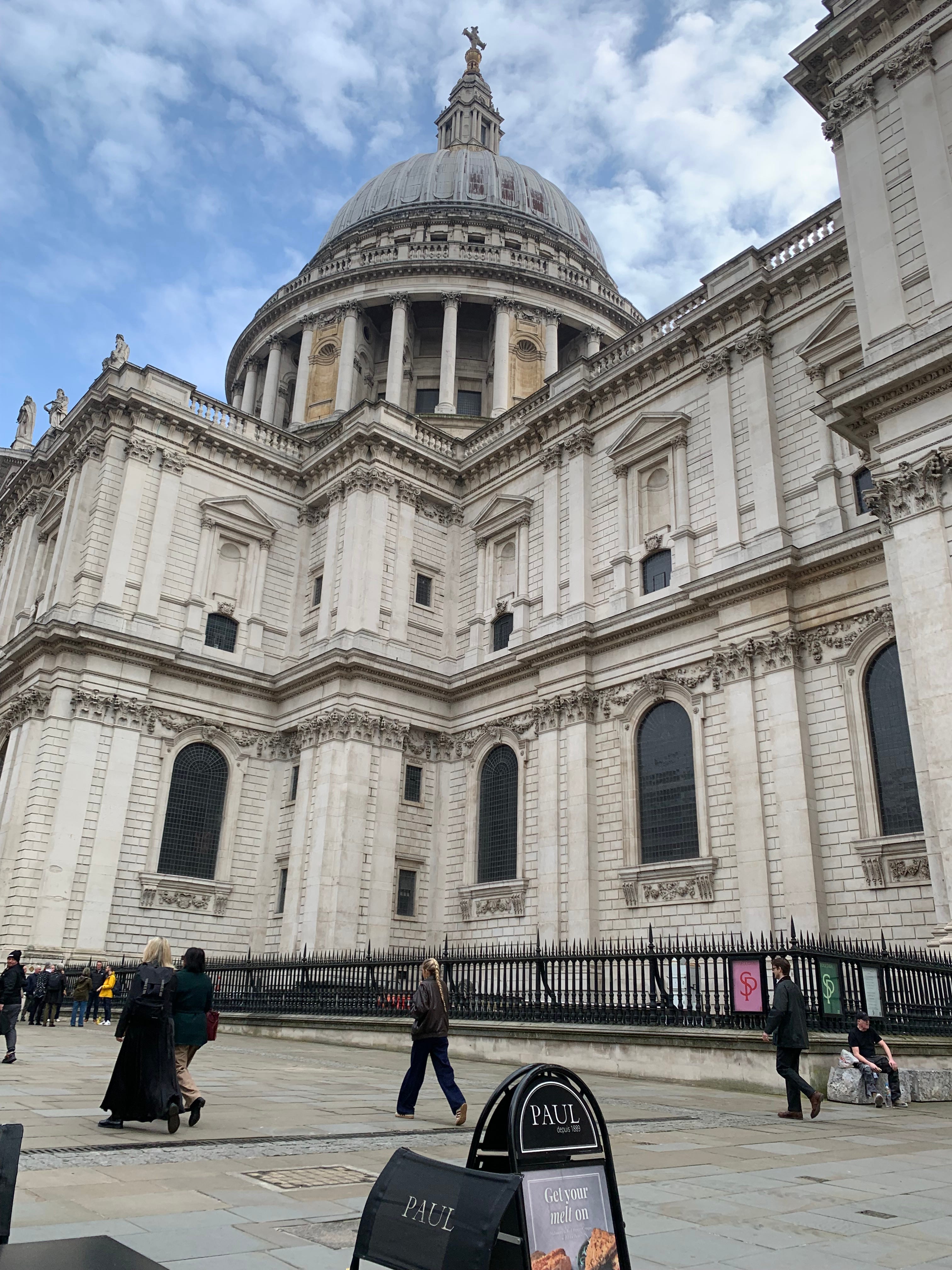
Pigeons and St Paul’s
It’s a cool, calm space down there, with a pigeon-free café and impressive tombs, statues and memorial stones everywhere you look, including Admiral Lord Nelson’s elaborate marble sarcophagus directly beneath the dome and the effigies of a Tudor couple. Amongst all this, you might not even notice the simply inscribed slab of black marble that marks the tomb of Sir Christopher Wren, ‘the Builder of this Cathedral Church of St Paul’s’. On a wall nearby there’s a plaque with a later dedication by Wren’s son that includes the famous words: ‘Lector, si monumentum requiris, circumspice’ (‘Reader, if you seek a monument, look about you’). You can see photo of this here.
At the entrance to the OBE chapel, there’s also a beautiful ledger stone marking the tomb of Mandell Creighton, Bishop of London from 1897 to 1901 and his wife Louise Creighton, whose ashes were added to the tomb following her death in 1936. This ‘Art Deco’ memorial stone was designed by James Powell and sons with help from Louise who, in the midst of her grief, suggested something similar to the black and white designs of the cathedral in Siena (a place she and Mandell loved). It was Louise who chose the line ‘Love is all and death is nought’ which is by Robert Browning, apparently, though I haven’t yet identified which poem it’s from.
In the end, the stonemason chose this ochre marble to depict the Bishop’s cope (ceremonial cloak) and the surrounding frame, see below. I think the colour works beautifully with the warm tones of the Crypt’s stone floor.
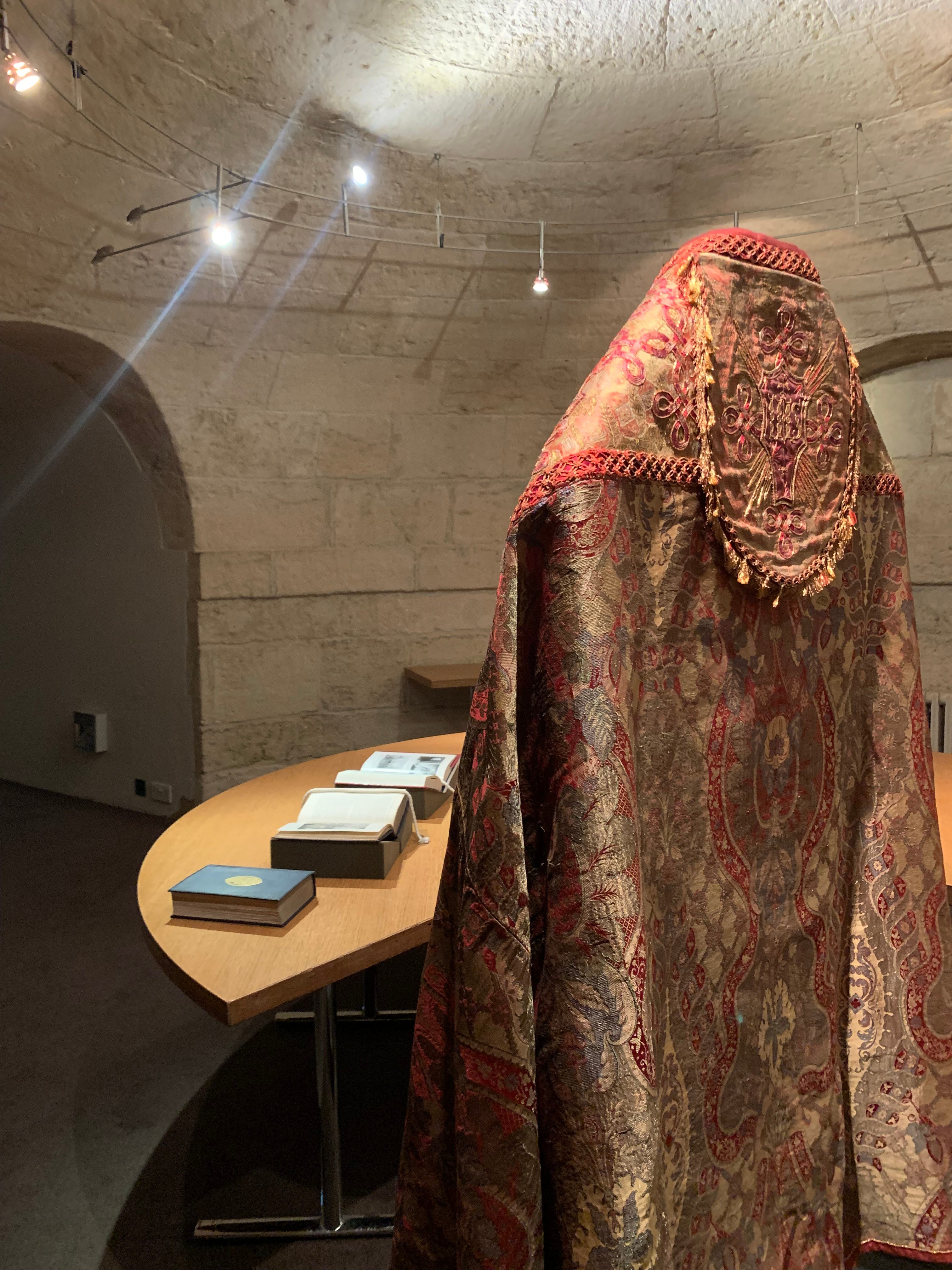
Amazingly, the real object was on display during my talk, in the circular room called, delightfully, ‘the beehive’. You can see my photo of it below. It’s made of red and gold silk with golden Japanese thread, and was made from material intended to be used for the coronation robe of Victoria, Princess Royal when she became German Empress and Queen of Prussia in 1888. But sadly, her husband died before the coronation took place, so instead it was made into a cope for the Bishop of London. Mandell Creighton wore it in 1897 for the St Paul’s service celebrating the Queen’s Diamond Jubilee. As he stood with the Archbishops on the steps of St Paul’s to welcome the Queen in her carriage, an awestruck reporter from the Daily Chronicle reported ‘His cope was of a stuff that taxes possibility of description… upon his head he wore a skull-cap of pure cloth of gold.’ When Queen Victoria later wrote to thank Mandell, she told him she had worried about him overheating in the sunshine.
Louise Creighton
I’ve written here about Louise Creighton’s work as a public historian, and how three of her books were exhibited with books by Wollstonecraft, Jane Austen and George Eliot at the specially constructed ‘Women’s Building Library’ in the Chicago World’s Fair of 1893. There’s more about her early life and how in 1890, with her friend Kathleen Lyttelton, she founded the Cambridge intellectual discussion club, the Ladies’ Dining Society, here. Reading her memoir again last week, I liked her refreshing honesty about how her crush on the writings of John Ruskin (‘I was… inclined to make Ruskin my prophet’) made her snobbish about any architecture that was not to his taste. ‘It is strange to me now to think that never before my marriage had I ever been inside Saint Paul’s nor dreamt that there could be anything to be said for city churches.’ (Memoir, p. 92)
We entered into the great current of the world’s life, ecclesiastical, social, to a certain extent political.’ (Louise Creighton, Memoir, p.123)
When her husband became Bishop of Peterborough in 1891, then Bishop of London from 1897, there was little time for Louise to continue with her own historical writing. ‘I think my mind, such as it was, was a student’s mind’ she later wrote. ‘I loved hunting up information and following out obscure points. If I had had the training, and the time and opportunity, I believe I would have loved to do research work.’ (quoted in Covert, 2000, p. 304). I wondered, reading this, if she managed occasionally to escape from her duties and spend time in the hidden library of St Paul’s, which I visited for the first time after giving my talk last week. It’s an astonishing place, and I’m pleased to report that Louise Creighton’s Life and Letters of Mandell Creighton is on the shelves there.
On the Triforium
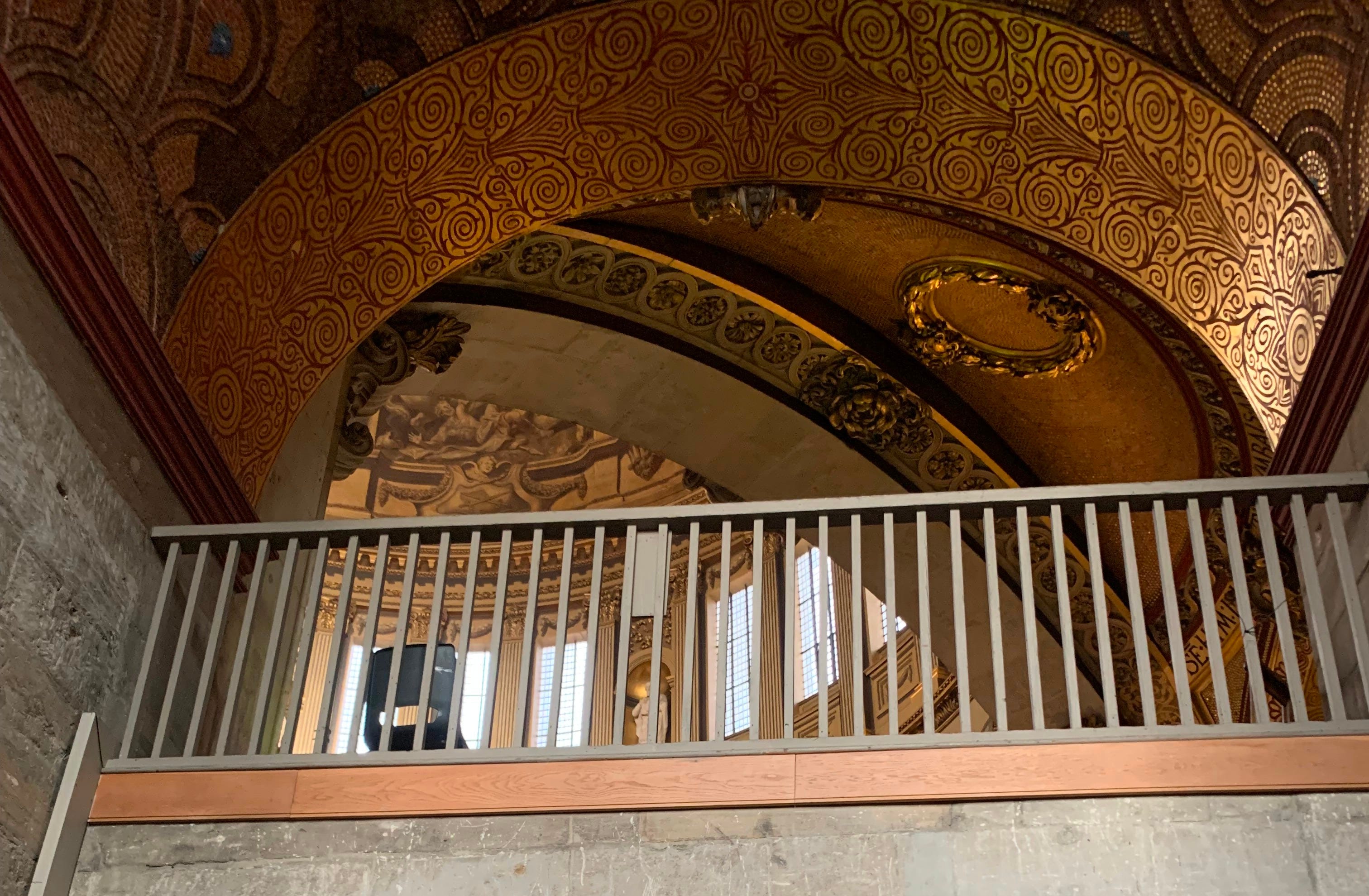
Carrying an armful of books, the organizer kindly led me up Wren’s ingenious cantilevered spiral ‘Geometric stair’ (there are some lovely photos of it here). We arrived on the Triforium, or interior gallery level, where, after carefully stepping over pipes and squeezing through a stone passageway, I looked up to see a mosaic ceiling that was as intricately decorated as Mandell Creighton’s cope (see my photo at the top). Just audible in that cool shady corridor was the sound of a choir practising on the cathedral floor far below. After going through a set of double oak doors I found myself in one of the best preserved eighteenth-century interiors in London, which – remarkably – has been kept in service since it opened in 1709 until it was closed for the four-year restoration project which began in 2018.
On the St Paul’s website here there is fascinating information about this, along with the history of how the library’s collection was put back together after the Great Fire of London of 1666, which destroyed the medieval cathedral that had originally stood on this site. It had long been falling into disrepair when the young physicist and astronomer, Christopher Wren, who had designed Oxford’s Sheldonian theatre in 1662, was asked for his ideas on how to rebuild St Paul’s. As part of his research, Wren travelled to Paris to consider the designs that inspired the Louvre museum and the domed churches of the city. In the spring of 1666 he submitted his plan for the dome of St Paul’s and on 27 August it was accepted. Less than one week later, on 2 September 1666, a fire began in a bakery in Pudding Lane and the ensuing conflagration destroyed much of the City of London including the old St Paul’s. It was thought that its thick stone walls would protect it, but in preparation for its planned restoration wooden scaffolding had been placed around the church, and the library’s entire collection of priceless books and manuscripts was lost.
Within days, Wren visited the site to view the devastation for himself, and drew up new plans for rebuilding the City. He also began work on his ideas for a completely new St Paul’s, with a dome, based on his interpretation of the European tradition of classicism. His plan was accepted in 1675, and building work began soon afterwards which was completed just 35 years later in 1710. Among his other projects at the time, including helping to rebuild London churches, Wren was also designing a new library for Trinity College Cambridge, which was built from 1676 until 1684 and is now famous as the Wren Library. Perhaps it was work on this that made him consider what sort of library he wanted for St Paul’s, as a place for a library to begin again. By 1710, the Library chamber was already being restocked with priceless texts, including one of only three surviving copies world-wide of Tyndale’s New Testament (1526). It was the first ever holy book to be printed in English, but viewed as heretical by the then Bishop of London, Cuthbert Tunstall. He ordered copies of it to be bought up and burned in the yard of St Paul’s Cathedral itself. After Wren’s library opened, a copy of it was smuggled in, its pages inserted inside another book, to keep it safe; there’s a very good History Today article about it here.

Wren’s hidden library
It’s moving to think about how in 1710, even after all the destruction of fire and the deliberate book-burning of the past, there was a chance to start afresh. I love discovering how historic libraries began to build their collections, and it’s moving to think about how Wren, who studied and taught at Oxford and had just built a beautiful new library in Cambridge, was thinking about the importance of books in his design for his hidden library in St Paul’s. This compact library isn’t there to impress us with its grandeur and it isn’t reserved for Oxbridge students and scholars. Rather, it is a peaceful space, tucked away on the cathedral’s Triforium. It’s just far enough away from the streets outside and the business of a working cathedral for a reader to come in, find a quiet corner and open a book. I like to imagine that Christopher Wren wanted others to experience the tranquillity of studying in this beautiful place, as he had enjoyed his own studies years earlier.
Below there are some of my photos from my recent visit… and read on to find out how to book your own visit there. My thanks to the staff of St Paul’s for kindly inviting me to give a talk, and for looking after me so well.
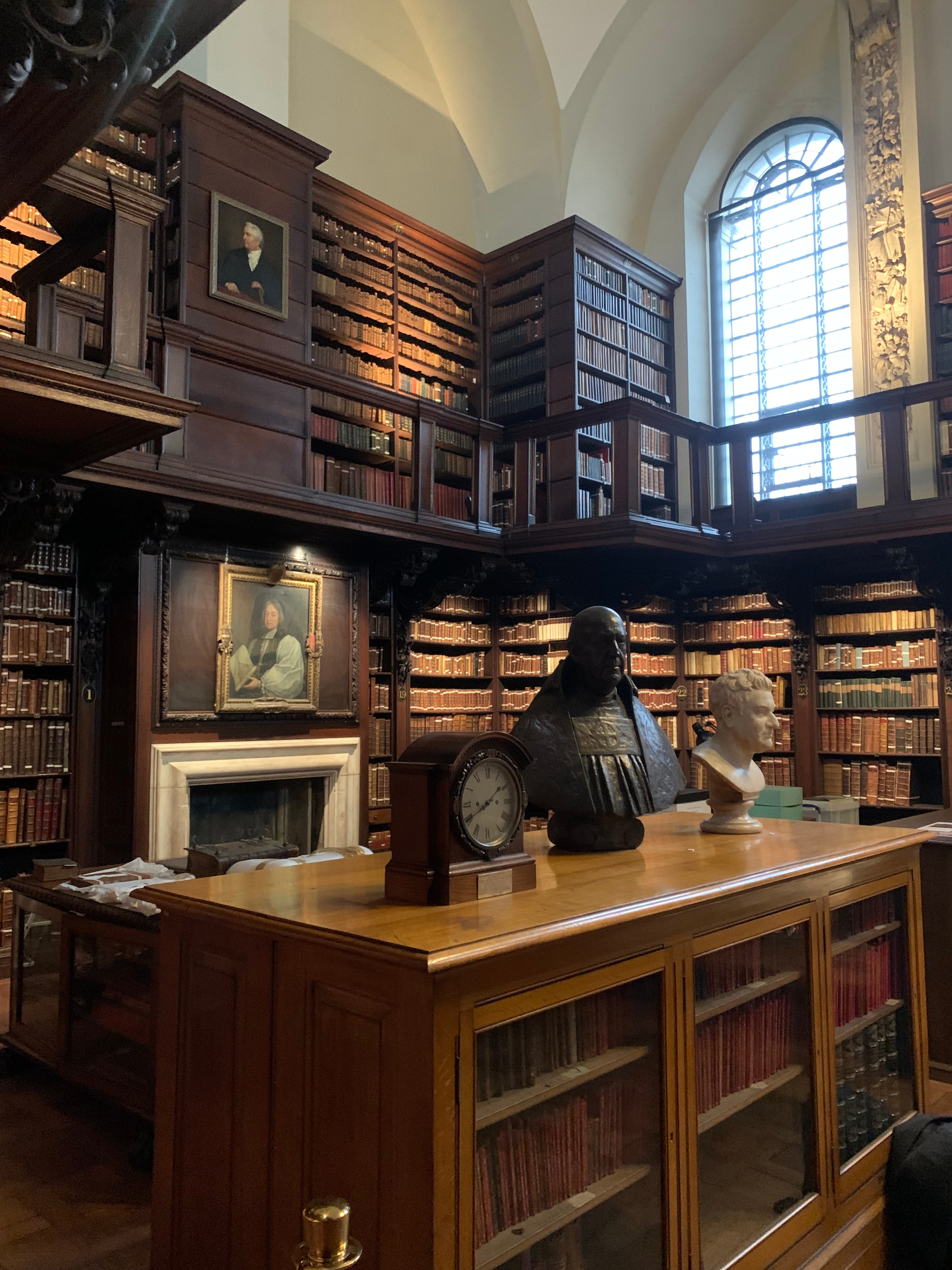
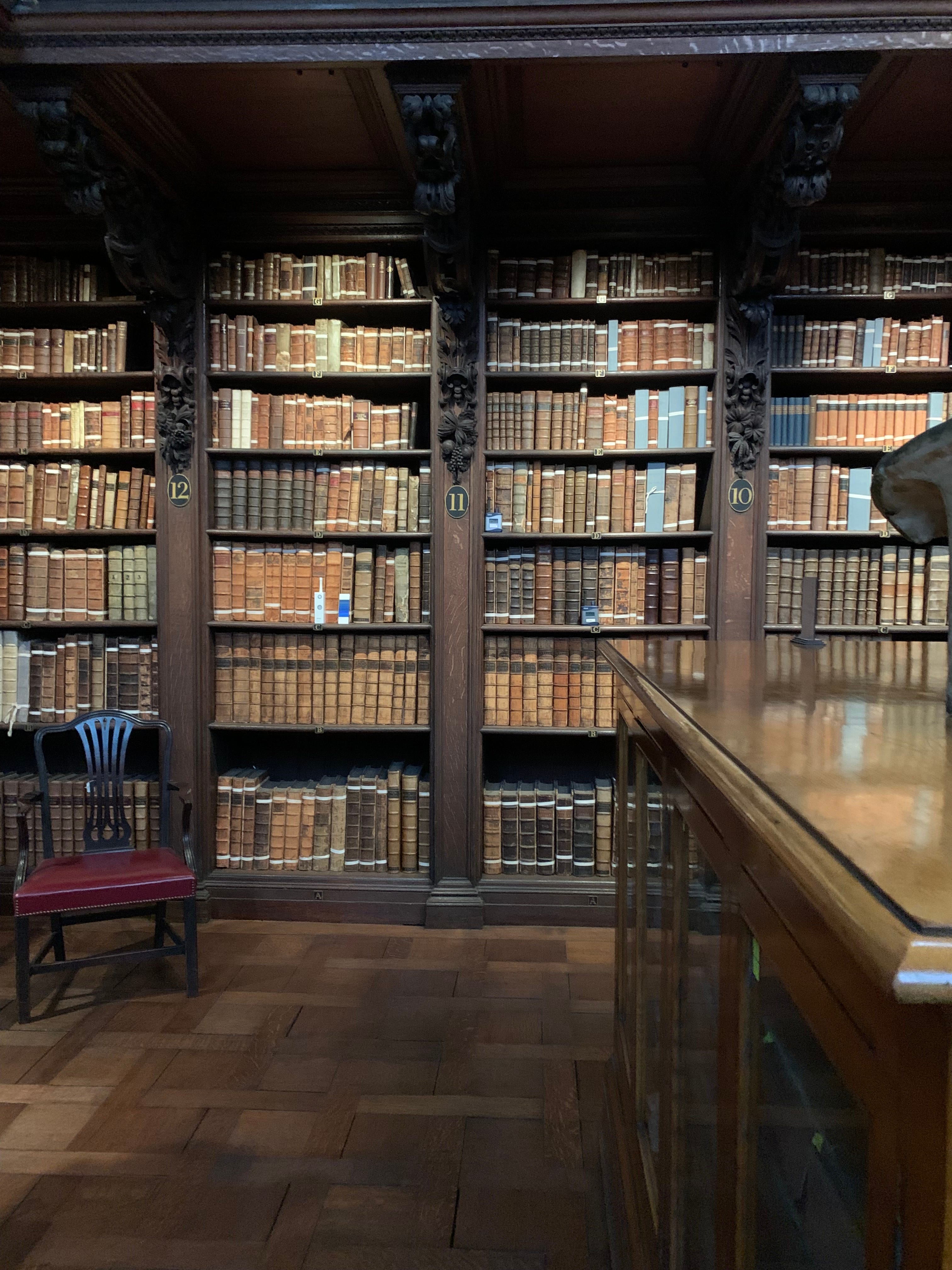
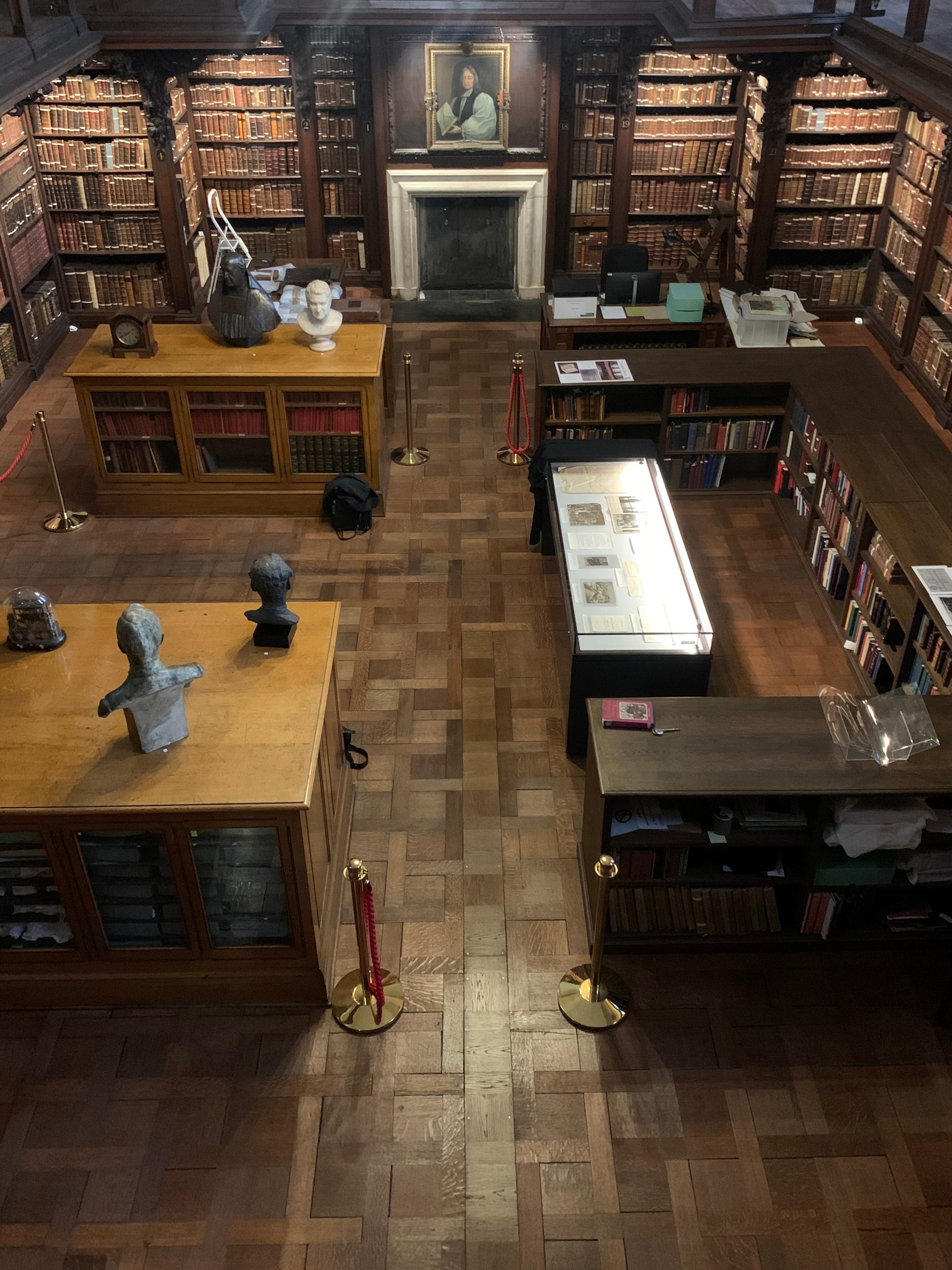
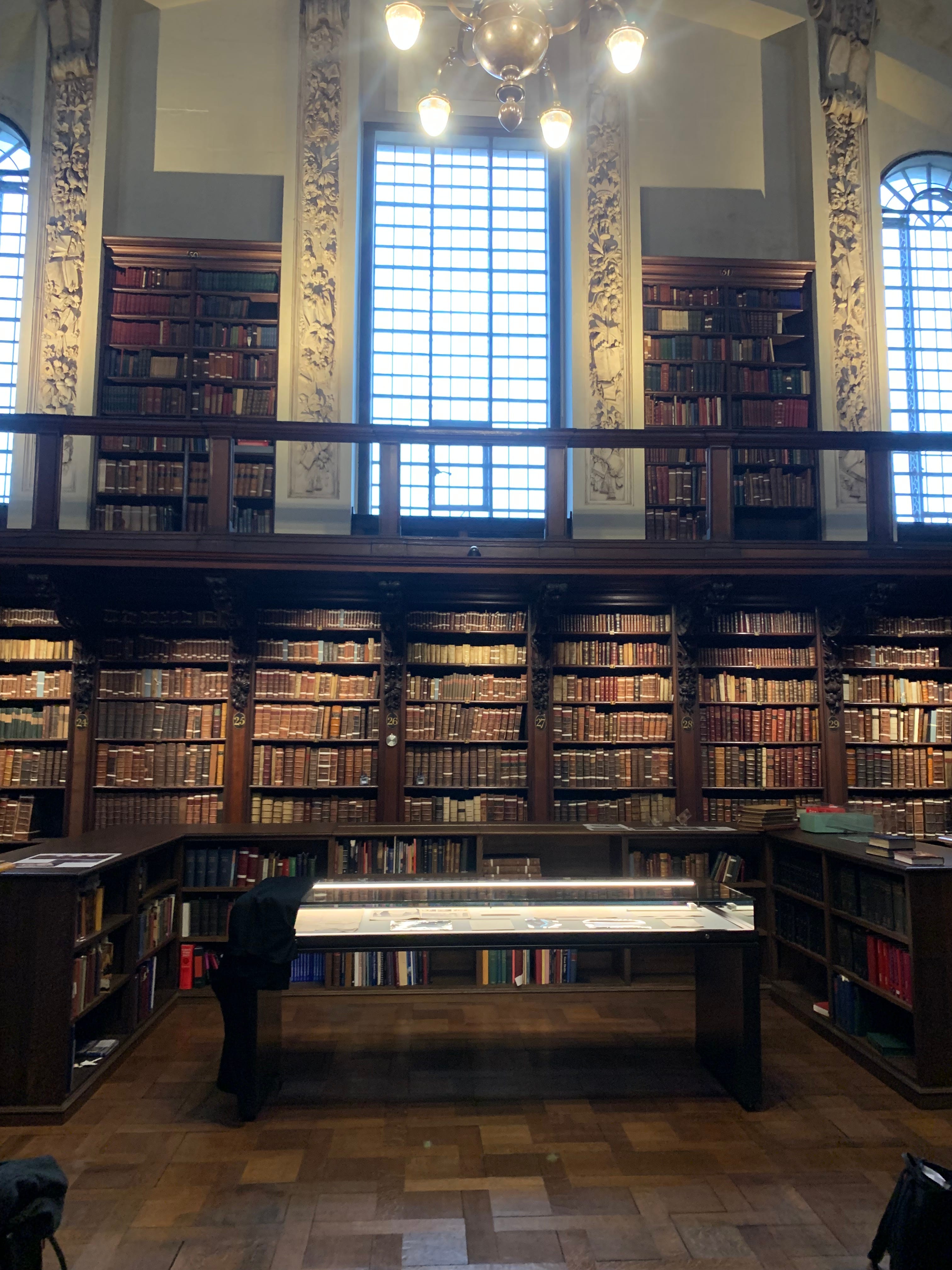
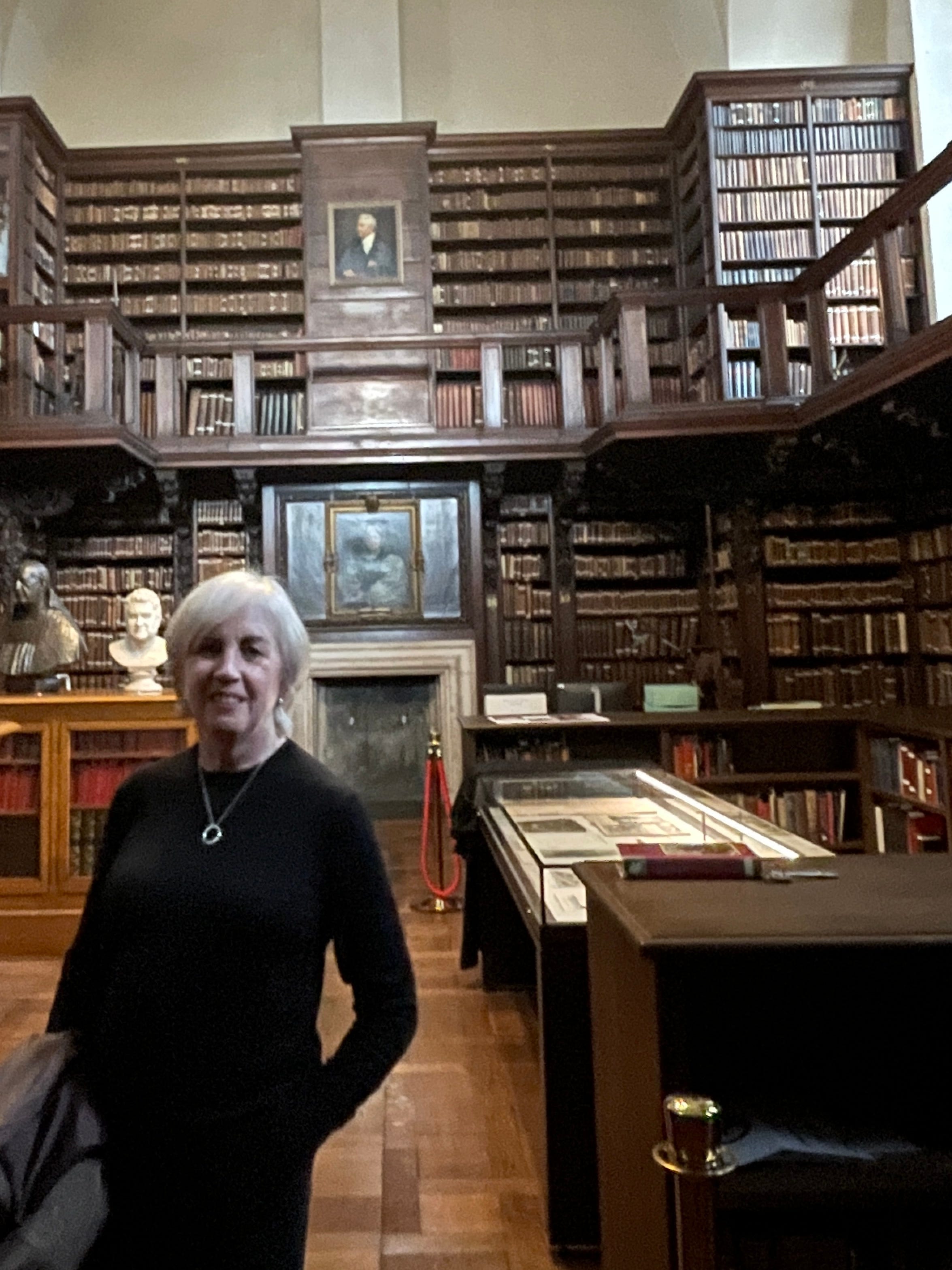
(You can find out more about the recent restoration on St Paul’s website here. The Library at St Paul’s Cathedral is open to readers by appointment, 10am-4pm, Tuesday to Thursday. For enquiries relating to the Library materials, including individual reader visits, please contact the Librarian. To visit the room with a guide, please book a triforium tour in addition to a sightseeing ticket).
Further reading
‘Christopher Wren 1632–1723’ in Encyclopedia Britannica; The Hidden Rooms Of St Paul’s Cathedral; J. T. Covert, A Victorian marriage: Mandell and Louise Creighton (Hambledon, 2000); Louise Creighton, Memoir of a Victorian woman: reflections of Louise Creighton, 1850–1936, ed. J. T. Covert (Indiana U.P., 1994); Lisa Jardine, On a Grander Scale: The Outstanding Career of Sir Christopher Wren (HarperCollins, 2003); Adrian Tinniswood, His Invention So Fertile: A Life of Christopher Wren (Pimlico, 2002).
Coincidentally, this article has just been published in History Today, April 2026: ‘Good News: The Afterlife of Tyndale’s Bible’.
The Bishop's wife

Hello, and a warm welcome to this week’s Cambridge Ladies’ Dining Society. Here’s my question. Have you read any good history books recently, enjoyed a historical podcast or visited a memorable place that has been preserved for centuries?


> It was Louise who chose the line ‘Love is all and death is nought’ which is by Robert Browning, apparently, though I haven’t yet identified which poem it’s from.
It's at the end of the epilogue to 'Fifine at the Fair'.
Wonderful tour! I'd love to see the library, which sounds like it's open to the public? And I wish I could have been there for your talk!